Plane Wave
Consider plane wave exp[j(kx-wt)] propagating along the x-axis where w = angular frequency, t is time and k is wave number.
Those constants can be defined as:
- its temporal periodicity that equals to:

- its spatial periodicity that equals to:

The energy of this wave is given by:

(Where:

h = Planck’s constant = 6.626*10^-34 Js = 4.1357*10^-15 eVs)
The momentum equals to:

To find which operator corresponds to observable E we determine the partial derivative of the plane wave equation in terms of time, t:
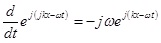
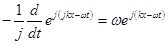
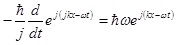

Therefore:

To find which operator corresponds to observable p we determine the partial derivative of the plane wave equation in terms of position, x:
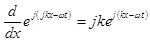
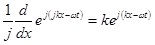
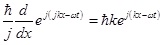

Therefore:

Now the question is which operator corresponds to observable x?
Answer:
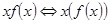
How does x^2 work as an operator? x^2 is composite operator:
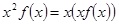
Where: xf(x) = Operator
= x(xf(x))
Where: x( ) = Operator, xf(x) = Function
= x(xf(x))
Where: x(xf(x)) = Function
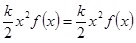

How does p^2 work as an operator?
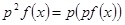
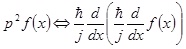
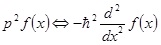
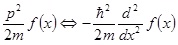
To summarise:
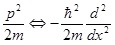

Going back to the classic harmonic oscillator the Hamiltonian operator is given by:
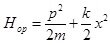
According to above derivations:
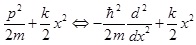
This equation is part of Schrodinger equation:
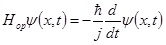

Now we can find time independent Schrodinger equation:
Let:
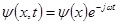

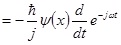
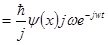


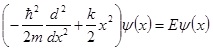
Thus we get time-independent Schrodinger equation: